






How to Budget for a Turnkey Bowling Alley: Pricing & ROI
- Understanding capital costs for entertainment venues
- What drives the bowling lane price
- Types of lanes and how they change costs
- Regulatory, standards and compliance impact on cost
- Detailed cost breakdown: start-up and one-time costs
- Major capital line items
- Comparing string pinsetters vs free-fall pinsetters
- Cost example: 12-lane mid-market alley
- Operating costs, revenue drivers, and ROI modeling
- Typical operating expenses (OPEX)
- Primary revenue streams
- Sample ROI / payback calculation
- Cost-saving strategies and financing options
- Practical ways to reduce bowling lane price and capex
- Financing, partnerships and incentives
- Choosing suppliers and validating quotes
- Putting it together: project checklist and next steps
- Essential pre-construction checklist
- Project governance and operational readiness
- Manufacturer and industry resources
- About Flying Bowling — supplier profile and why it matters
- FAQ — common questions about bowling lane price, costs and ROI
- 1. What is the average cost per lane to install a turnkey bowling lane?
- 2. Are string pinsetters significantly cheaper than traditional pinsetters?
- 3. How long until I can expect to recover my investment?
- 4. What are the hidden costs new owners often overlook?
- 5. Where can I find reliable equipment suppliers and references?
- 6. How should I model seasonality and leagues in revenue forecasts?
- Contact and next steps
Planning a turnkey bowling alley requires accurate estimates of the bowling lane price, equipment and construction costs, and a clear ROI model tied to local demand. This article walks you through the capital expenditures and ongoing operating costs that shape project feasibility, provides sample cost tables and a pro forma ROI example, and recommends ways to reduce risk and improve payback—backed by industry references and supplier information. Keywords and concepts covered include bowling lane price, lane installation cost, pinsetter price, string pinsetter, turnkey bowling alley, alley ROI, maintenance cost, and payback period.
Understanding capital costs for entertainment venues
What drives the bowling lane price
“Bowling lane price” is not a single figure: it covers lane surface materials and installation, pinsetting machines, scoring and monitors, approach and lane conditioning systems, gutters and ball returns, lane-level lighting and automation. Additional related capital items include building improvements, HVAC, plumbing for restrooms and kitchens, fire suppression, and acoustical treatment. Industry associations such as the Bowling Proprietors' Association of America (BPAA) provide operator guidance and market data for these categories (BPAA).
Types of lanes and how they change costs
Standard ten-pin lanes (synthetic or wooden facing) are the most expensive when built to professional standards. Duckpin and boutique lanes (shorter lanes, smaller balls) cost less in lane surface and lane length but still require pinsetters and specialized pin/pit systems. String pinsetters, increasingly popular for smaller budgets, reduce per-lane equipment and maintenance costs compared with traditional free-fall pinsetters.
Regulatory, standards and compliance impact on cost
Sanctioned lanes and competitive play must meet specifications set by bodies like the United States Bowling Congress (USBC) (USBC) and local building codes. Costs for compliance—inspection, lane certification, fire and accessibility—should be budgeted early. Non-compliance can stop operations, so allow contingency for corrections.
Detailed cost breakdown: start-up and one-time costs
Major capital line items
Below are the typical major one-time costs when building a turnkey bowling alley. Ranges reflect variability by region, scope and supplier. Use these as starting estimates for a feasibility pro forma.
| Item | Typical cost range (USD) | Notes / Source |
|---|---|---|
| Land / site preparation | $50,000 – $1,000,000+ | Highly variable by market; includes grading and utilities |
| Building shell & construction | $200,000 – $2,000,000+ | Depends on size, finishes, F&B spaces |
| Lane installation (per lane) | $20,000 – $75,000 per lane | Includes lane surface, approaches, gutters, installation |
| Pinsetters (equipment) | $10,000 – $60,000 per lane | String pinsetters at lower end; free-fall mechanical/automatic higher |
| Scoring & displays | $2,000 – $10,000 per lane | Modern touchscreen and POS integration raises cost |
| F&B kitchen & bar fit-out | $50,000 – $500,000+ | Dependent on menu and capacity |
| Furniture, fixtures & equipment (FFE) | $20,000 – $200,000+ | Seating, pro shop, lighting, signage |
| Professional fees & permits | $20,000 – $150,000 | Architect, engineering, permits |
| Initial inventory & working capital | $10,000 – $200,000+ | Food inventory, repair parts, payroll cushion |
| Contingency (recommended) | 10% – 20% of capex | Reserve for overruns |
Estimates above are industry-based ranges assembled from supplier pricing and operator reports (see BPAA for operator resources and member data; see manufacturer pages such as Flying Bowling for equipment specifics: Flying Bowling).
Comparing string pinsetters vs free-fall pinsetters
Choosing between string pinsetters and traditional free-fall pinsetters is a major determinant of bowling lane price. String pinsetters generally have:
- Lower purchase price and lower per-lane installation cost
- Lower maintenance requirements and fewer spare parts
- Different game feel—some serious leagues prefer free-fall due to pin action
Free-fall pinsetters (traditional) cost more upfront and require greater technical maintenance but are favored for sanctioned competition and high-end centers. Manufacturers' published specs and pricing (such as Flying Bowling's string pinsetter product lines) are good primary sources when comparing options (Flying Bowling).
Cost example: 12-lane mid-market alley
Below is a simplified example capital budget for a 12-lane center intended to illustrate scale; adjust to local costs and design:
| Line item | Unit | Qty | Unit cost (USD) | Total (USD) |
|---|---|---|---|---|
| Lane installation | per lane | 12 | $35,000 | $420,000 |
| String pinsetters | per lane | 12 | $12,000 | $144,000 |
| Scoring & displays | per lane | 12 | $3,000 | $36,000 |
| Building & construction | lump | 1 | $800,000 | $800,000 |
| F&B & FFE | lump | 1 | $200,000 | $200,000 |
| Professional fees & permits | lump | 1 | $75,000 | $75,000 |
| Working capital & inventory | lump | 1 | $50,000 | $50,000 |
| Contingency (12%) | lump | 1 | $220,800 | |
| Total estimated capex | $1,945,800 |
This is an illustrative budget. Exact bowling lane price and total project capex vary by site, finishes, local labor and the selected pinsetter technology.
Operating costs, revenue drivers, and ROI modeling
Typical operating expenses (OPEX)
Ongoing costs determine sustainable cash flow and payback. Typical OPEX categories include:
- Salaries and payroll taxes (management, front desk, F&B, maintenance)
- Maintenance and parts (pinsetter service, lane oiling, lane resurfaces)
- Utilities (electric for pinsetters and HVAC; water for restrooms/kitchen)
- Rent or mortgage, insurance, property taxes
- Marketing, POS fees, software subscriptions
Operators commonly budget 25%–45% of revenue for combined payroll + cost of goods sold (for F&B) and another 10%–20% for maintenance and utilities. These ranges depend on local wages and utility costs.
Primary revenue streams
Revenue centers for most alleys include:
- Lane fees and hourly play
- League fees and tournament hosting
- Food & beverage sales
- Pro shop and equipment rental
- Events, parties and birthday packages
- Arcade, VR or other amenity fees (if present)
Successful centers diversify revenue: many rely on F&B for higher margins while lane fees provide steady volume. League play provides off-peak utilization and recurring income.
Sample ROI / payback calculation
Use conservative occupancy and pricing assumptions to estimate EBITDA and payback. Below is a simplified annual pro forma for the 12-lane example above.
| Assumption | Value |
|---|---|
| Average lanes in use per hour (peak & off-peak weighted) | 6.0 lanes |
| Average hourly lane rate (per lane) | $25 |
| Hours open per week | 70 |
| Annual lane revenue | $546,000 (6 lanes * $25 * 70 hrs * 52 weeks) |
| F&B and other revenue | $400,000 |
| Total revenue | $946,000 |
| Operating expenses (incl payroll, utilities, COGS) | $590,000 (≈62% of revenue) |
| EBITDA | $356,000 |
| Capex (from example) | $1,945,800 |
| Simple payback period | ≈5.5 years (Capex / EBITDA) |
This simplified calculation ignores taxes, loan interest and depreciation. For financial decisions, build a full three- to five-year pro forma including debt service, sensitivity to lane utilization, and seasonal variability. For payback and capital budgeting concepts see Investopedia's payback period guide (Investopedia).
Cost-saving strategies and financing options
Practical ways to reduce bowling lane price and capex
Strategies to lower initial cost without compromising revenue potential:
- Choose string pinsetters for new market or family entertainment centers to reduce equipment and ongoing maintenance cost.
- Phase construction: open fewer lanes initially and expand as demand grows.
- Lease equipment or negotiate manufacturer financing to smooth capital outlay.
- Use modular or pre-fab construction methods to reduce onsite labor time.
- Source multi-purpose spaces (e.g., combined arcade/event room) to maximize revenue per square foot.
Financing, partnerships and incentives
Common financing sources include bank loans, SBA loans (in some countries), equipment leasing programs, and private equity partners. Local economic development agencies sometimes offer incentives for hospitality/entertainment projects that create jobs—check municipal and regional programs. When negotiating financing, model debt service in your pro forma and maintain contingency reserves.
Choosing suppliers and validating quotes
Get multiple bids for lanes and pinsetters and verify warranty, spare parts availability and maintenance support. Use manufacturer certificates and references: quality certifications (CE, RoHS) and workshop scale can indicate reliability and scale of production—review suppliers' documented certifications and client case studies. For manufacturer details see Flying Bowling's product and certification information (Flying Bowling).
Putting it together: project checklist and next steps
Essential pre-construction checklist
- Market study: demand, competition, price sensitivity and seasonality
- Feasibility pro forma with multiple scenarios (base, downside, upside)
- Site selection with zoning and utilities confirmed
- Preliminary equipment bids (lanes, pinsetters, scoring)
- Architectural schematic and preliminary construction estimate
- Financing plan and committed capital or loan pre-approval
Project governance and operational readiness
Assign a project manager, set a timeline with milestones (permitting, construction, equipment delivery, staff hiring, soft opening), and prepare operational manuals: maintenance schedules, inventory lists, and marketing plan for opening. Engage a certified lane technician for installation and training from the equipment supplier.
Manufacturer and industry resources
When specifying equipment, check the supplier's manufacturing capacity, certifications and after-sales support. Reliable manufacturers publish technical specs, certifications and case studies. For background on the sport and lane standards, the bowling overview at Wikipedia is useful (Bowling — Wikipedia), while industry operator resources are available from BPAA (BPAA).
About Flying Bowling — supplier profile and why it matters
Since 2015, Flying Bowling has specialized in researching and developing state-of-the-art pinsetter bowling equipment. We provide a comprehensive range of bowling alley equipment and venue design and construction services. Our bowling equipment has obtained major global certifications, including CE and RoHS. We have a 10,000-square-meter bowling equipment manufacturing workshop. We produce and sell bowling string pinsetters and construct and modernize standard and duckpin bowling alleys. We offer a comprehensive, one-stop service to bowling alley customers around the world, and we also recruit dealers in the global market to promote the growth of the bowling industry. We already have long-term, stable cooperative relationships with dealers in Asia, Europe, the Middle East, and beyond. Our vision is to become a leading global bowling equipment brand. For product details and contact: https://www.bowlingflying.com/
Flying Bowling's competitive strengths include focused R&D (since 2015), an integrated manufacturing workshop, CE/RoHS certification for equipment safety/compliance, and a product range that includes string pinsetters (cost-effective, low-maintenance option), traditional pinsetters, and solutions for both Standard Bowling and Duckpin Bowling. These strengths reduce supplier risk and simplify procurement for turnkey projects, especially for operators seeking one-stop procurement and installation.
FAQ — common questions about bowling lane price, costs and ROI
1. What is the average cost per lane to install a turnkey bowling lane?
Depending on lane type and equipment, the lane-specific cost (lane surface, gutters, pinsetters, scoring) typically ranges from $30,000 to $85,000 per lane. The full project cost per lane drops as facility size increases and shared infrastructure is amortized. See supplier quotes and industry ranges cited above.
2. Are string pinsetters significantly cheaper than traditional pinsetters?
Yes—string pinsetters usually have lower purchase price and lower maintenance costs, often reducing per-lane equipment cost by 30%–60% versus new free-fall systems. The trade-off is a different pin action; some competitive bowlers prefer free-fall machines.
3. How long until I can expect to recover my investment?
Simple payback for a well-run mid-market center is commonly 4–8 years based on typical projections; this depends on lane utilization, F&B margins, financing costs and local market demand. Build multiple scenarios in a financial model for accurate forecasting (see Investopedia for payback concepts: Payback period).
4. What are the hidden costs new owners often overlook?
Commonly overlooked items include higher-than-expected utility costs, spare parts inventory for pinsetters, lane resurfacing every few years, software and subscription fees for scoring/POS, marketing costs to drive initial traffic, and contingencies for permitting delays or compliance corrections.
5. Where can I find reliable equipment suppliers and references?
Seek suppliers with documented certifications, manufacturing scale and client references. Industry associations like BPAA can provide operator references and supplier directories (BPAA). Manufacturer sites such as Flying Bowling present product lines, certifications and case studies (Flying Bowling).
6. How should I model seasonality and leagues in revenue forecasts?
Include league contracts as recurring revenue (typically in off-peak hours) and model weekend/holiday peaks separately. Use conservative assumptions for weekday utilization and build promotions/partnerships to increase midweek traffic.
Contact and next steps
If you’re planning a turnkey bowling alley and need equipment quotes, technical specs or a site-specific budget, contact manufacturers and request detailed proposals that include installation, training and spare parts. For equipment and turnkey solutions, explore Flying Bowling’s product and project services at https://www.bowlingflying.com/. To get started, prepare a concise project brief (location, target lane count, market positioning—family, entertainment, league, boutique) and request a site consultation and equipment package.
For customized quotes and professional consultation on bowling lane price, turnkey construction and ROI modeling, contact Flying Bowling through their website: https://www.bowlingflying.com/.
How much does it cost to Build a Bowling Alley in Lithuania | Flying Bowling Expert Guide
How much does it cost to Build a Bowling Alley in Ireland | Flying Bowling Expert Guide
How much does it cost to Build a Bowling Alley in Hungary | Flying Bowling Expert Guide
How much does it cost to Build a Bowling Alley in Greece | Flying Bowling Expert Guide
How much does it cost to Build a Bowling Alley in Germany | Flying Bowling Expert Guide
Products
Does your bowling equipment meet international standards?
It meets international standards. The equipment strictly follows the US USBC (United States Bowling Congress) international standard certification, which is one of the highest standards recognized by the global bowling industry. USBC certification ensures that our equipment has reached the international top level in terms of safety, durability, performance and user experience.
What types of bowling equipment do you have?
Flying Classic Standard Bowling (FCSB), Flying Smart Duckpin Bowling (FSDB), Flying Ultra Standard Bowling (FCSB Ultra)
Service
Do you provide regular maintenance services?
You can sign an annual maintenance agreement, which includes quarterly inspections, lubrication maintenance, system upgrades and other services.
Installations
How long does it take to install bowling equipment?
The installation process can take between 2-4 weeks, depending on the size of the project and the specific type of equipment being installed.
How long does it take to install the equipment?
It takes about 7-15 days for a standard venue, and it takes an average of 2 days to install a fairway.
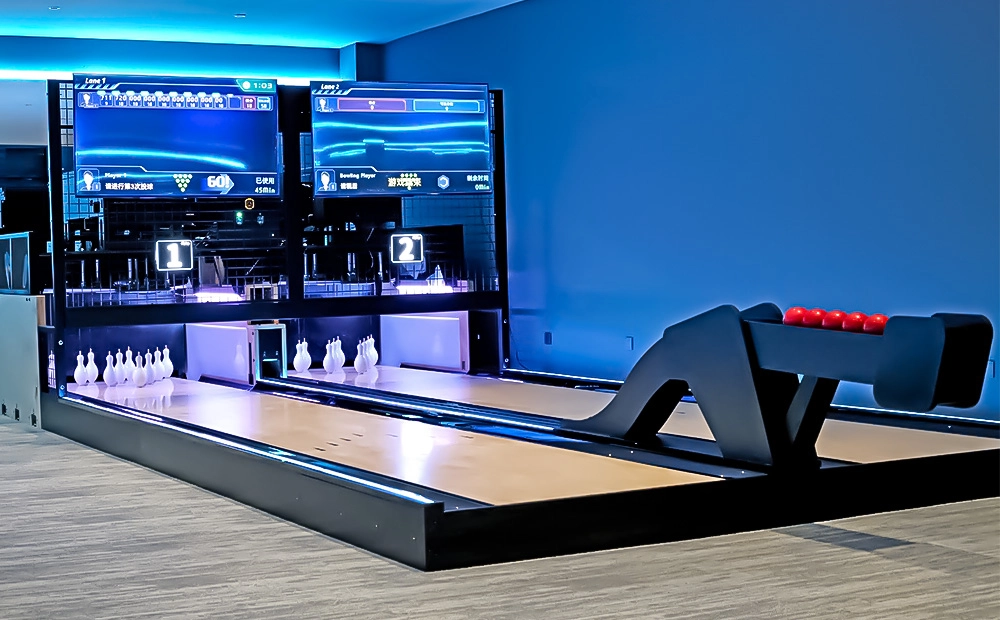
Flying Smart Duckpin Bowling
The innovative design of Flying Smart Duckpin Bowling (FSDB) makes it perfect for places like bars, billiard halls and game centers. It makes people want to come back more often and spend more money. FSDB is fun and competitive, so it will become a new focus for social activities.
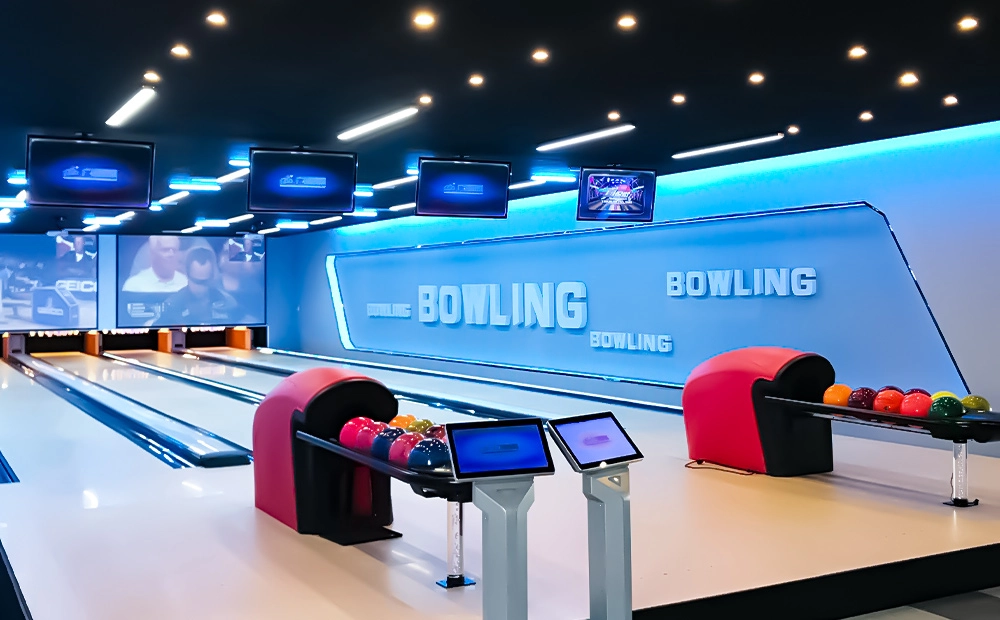
Flying Classic Standard Bowling
Flying Classic Standard Bowling (FCSB) employs the World Standard Competition Scoring System to deliver a more professional bowling experience, enabling bowlers to enjoy a professional-standard match at their convenience.
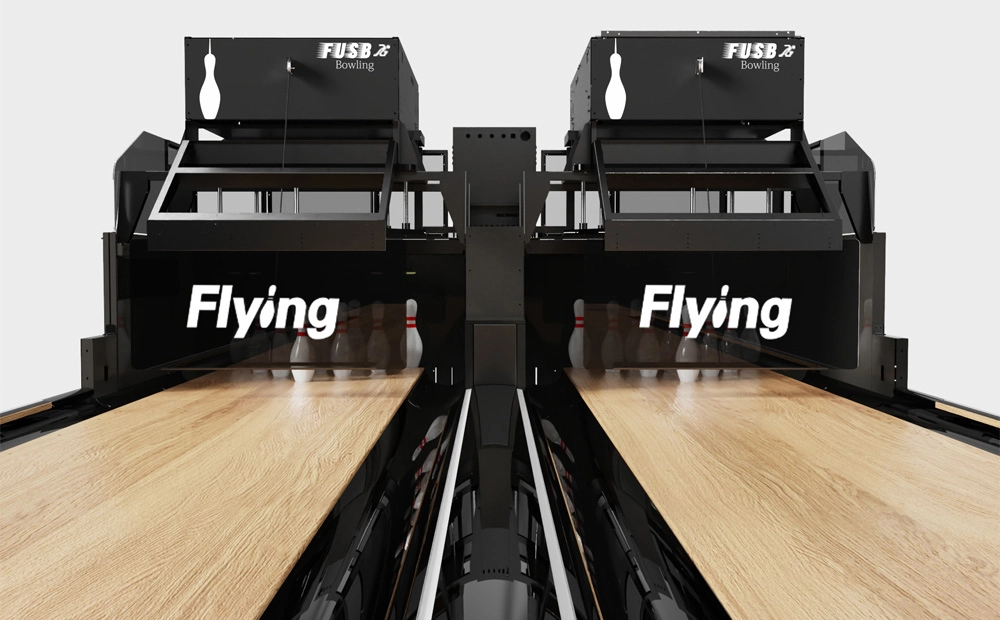
Flying Ultra Standard Bowling
Flying Ultra Standard Bowling (FUSB) Upgraded Version
The string pinsetter uses the latest technology. It offers a more enjoyable bowling experience thanks to its innovative designs and modern technology.

Facebook
YouTube
Linkedin
Twitter